Your gas fireplace dies on the first cold night of October. The tech quotes $450 to fix a fireplace that cost $3,500 installed. Fair question: are you maintaining it, or throwing good money at a unit that's already on borrowed time?
Most owners guess. They either repair three times in five years and end up spending more than a new insert, or they replace a 12-year-old unit over a $175 thermocouple. Both mistakes come from not having a framework.
This one settles it. Gas fireplace repairs run $200–$1,000 in 2026, and a new gas insert runs $2,000–$5,000+ installed (Angi, 2026). The line between repair and replace comes down to three things: how old the unit is, what actually broke, and how many times you've already fixed it. The table below puts numbers on all three — including what your service call actually pays for, based on federal wage data most cost guides never touch.
What Gas Fireplace Repairs Actually Cost (2026)
| Failed part | 2026 repair cost | Notes |
|---|---|---|
| Igniter replacement | $90–$150 | Most common no-heat call |
| Pilot light repair | $100–$350 | Includes cleaning and thermopile checks |
| Thermocouple replacement | $150–$350 | The classic "pilot won't stay lit" fix |
| Gas valve replacement | $225–$400 | Parts $100–$225, labor $125–$175 |
| Typical full repair | $200–$1,000 | National average, most jobs land mid-range |
Sources: our gas fireplace repair cost guide, HomeAdvisor 2026 data, and Ohio Gas's 2026 valve breakdown. The full guide covers every part, plus emergency call premiums.
Two things jump out of that table. First, nothing on the common-failure list crosses $400 — even the scary-sounding gas valve. Second, the spread between a $90 fix and a $400 fix is mostly labor, not parts. Keep that in mind for the threshold math coming up.
But here's where it gets expensive: those are the repairs that go well. The ones that don't are the reason this article exists.
The Repair-or-Replace Threshold Table
This framework is built from the published price ranges above. No manufacturer publishes one, which is exactly why owners guess.
The 25/50 rule: if the repair quote is under 25% of what a new insert costs installed, repair it. Between 25% and 50%, age decides. Over 50%, replace — the repair is buying you a unit that's already halfway out the door.
| Fireplace age | One repair under $400 | Repair $400–$1,000 | Second repair in 3 years |
|---|---|---|---|
| Under 10 years | Repair — almost always | Repair, get 2 quotes | Check warranty first |
| 10–15 years | Repair | Judgment call — lean repair | Lean replace |
| 15–20 years | Repair if it's the first | Lean replace | Replace |
| 20+ years | Repair only if budget forces it | Replace | Replace |
Three honest caveats. Lifespan is industry common knowledge, not a published spec — most manufacturers rate gas inserts for 15–25 years of service with annual maintenance, and units that skip servicing die closer to 15. Second, parts availability: a 22-year-old unit with a failed proprietary valve can be unrepairable at any price, because the part doesn't exist anymore. Third, the table assumes the firebox and venting are sound — section five covers the failures that override everything.
Here's the math that makes the table work. A $350 thermocouple job on a 12-year-old unit is 14% of a $2,500 replacement — clear repair. A $900 valve-and-pilot job on an 18-year-old unit you've already repaired twice is 36% of replacement cost, on a unit past its rated lifespan, with $1,100 of prior repairs behind it. That's a $2,000 replacement decision wearing a repair estimate as a disguise.
Run the same math over a decade and the answer usually favors repair — until it doesn't. Keeping a 10-year-old unit with $260-a-year service and two typical repairs (a $250 thermocouple, a $225 gas valve) costs about $3,075 over ten years. Replacing now at $3,750 with $200-a-year service costs about $5,750. Repair wins on cash by roughly $2,675 — unless a single quote crosses about $1,900, or the unit is already past 15 with prior repairs behind it. The cost guide's 10-year model lays out the assumptions.
Still with me? Good — because the next section explains the number on your quote that nobody breaks down: labor.
Why a $90 Part Becomes a $350 Repair Bill
The part is rarely the expensive half. Labor is — and federal wage data explains why.
The tech who shows up is an HVAC mechanic. The Bureau of Labor Statistics tracks the occupation as SOC 49-9021, with 409,670 employed nationwide as of May 2025. Hourly pay runs from $19.25 at the 10th percentile to $45.78 at the 90th, with the median at $29.33 (BLS OEWS, May 2025).
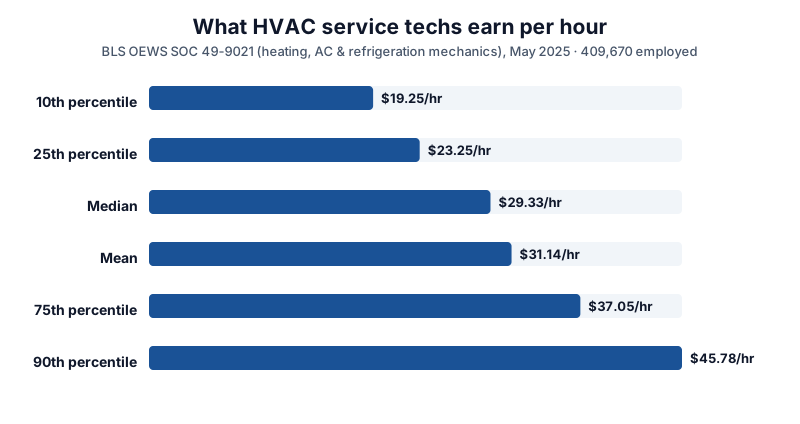
Now the honest part: your tech doesn't bill you $29 an hour. Fireplace and HVAC service calls bill at $50–$150 per hour in most markets — industry-standard rates, not government data. The gap covers what your $29-an-hour tech costs the company beyond wages: payroll taxes, workers' comp and liability insurance, the service truck and its fuel, the dispatcher who booked you, and the trip fee just to roll a van to your door — often equal to a full hour of labor before the tech touches anything.
Run the math on a typical gas valve job: $100–$225 in parts (Ohio Gas, 2026), plus two hours of billed labor at $75–$125 an hour, plus the trip fee. You land right in that $225–$400 total. Nothing on the invoice is padding — the rate structure just works that way for every trade that rolls a truck. Our breakdown of how contractor labor costs actually build up covers the same math for any trade.
The catch? This is also why tiny repairs and big repairs feel weirdly similar on price. A 30-minute igniter swap and a 2-hour valve job both carry the trip fee, so the igniter "costing" $150 installed isn't a ripoff — it's the van ride.
What Replacement Actually Costs
If the threshold table says replace, here's the real number to expect — because the sticker on the insert is not the invoice.
A gas fireplace insert itself runs $2,000–$5,000 installed (Angi 2026 fireplace remodel data; Embers Fireplaces' 2026 guide lands in the same band). Add removal and disposal of the old unit and the national all-in average comes to about $5,200 (Planika Fires, US guide, 2026). Line items that move the total:
- Venting work: direct-vent inserts need proper termination — $500–$1,500 if the existing chimney liner needs work
- Gas line modifications: $150–$800 depending on run length and code requirements
- Facing and trim: if you change insert size, surrounding stone or tile work adds $300–$1,000
- Electrical: modern units with blowers and remotes may need an outlet near the firebox
A full rebuild — firebox, chimney structure, the works — runs $1,000–$3,500 on its own before the insert (Angi, 2026). That's the scenario where water damage found one repair call, and put plainly: if a chimney sweep quotes you masonry work and a tech quotes you a fireplace in the same visit, get the masonry fixed first. A new insert above a leaking chimney is a new insert with an expiration date.
Efficiency is the quiet offset. Most 15-year-old units are millivolt standing-pilot designs that burn gas around the clock; a modern direct-vent insert with electronic ignition cuts standing pilot waste and heats the room more evenly. This guide won't invent a payback period — it depends on your gas rates and how much you actually run the thing. But if the old pilot light has been burning since the Obama administration, the waste is real.
And if you're replacing because the room never warmed up in the first place, size it before you buy — our furnace size calculator does the BTU math for the space, and the same output bounds what an insert needs to deliver.
Five Repairs That Are Never Worth the Money
Some failures override the table completely. Money spent on these is money spent on a fireplace that still can't be safely used.
1. Cracked or spalling firebox panels. Refractory panels contain the fire; cracks let heat reach the steel chassis and combustibles behind the wall. Panels are sometimes replaceable — but a cracked firebox on an older builder-grade unit usually means the chassis is compromised. Replace.
2. Water damage inside the firebox. Rust streaks, corroded burner assemblies, mineral deposits. Water got in through the chimney or a failed flashing, and it's already eaten parts you can't fully inspect. Fix the leak, then price the unit — assume it's totaled until a tech certifies otherwise.
3. Discontinued or proprietary parts. Gas valves and control boards are model-specific. When a 20-year-old unit's valve is out of production, no amount of repair budget fixes it. Ask the tech for the part number before approving anything.
4. Anything involving the heat exchanger or a CO concern. If a tech finds a compromised heat exchanger or reports combustion spillage, that's a carbon monoxide risk. This one isn't an economics question — the unit comes out. Every home with a gas appliance should have working CO detectors; if yours are missing, fix that before the next fire, not after.
5. The third repair in five years. By the third repair, you've typically crossed 40–50% of replacement cost cumulatively, and the unit has told you its temperament. Furnaces get the "repair twice, then replace" wisdom for the same reason. Fireplaces are cheaper to run than furnaces but no cheaper to out-repair.
Notice what's not on the list: age alone. A well-maintained 18-year-old unit that ignites on the first press every October doesn't need replacing because it's old. It needs an annual service call — typically $150–$250 — and a clean pilot assembly.
What an Experienced Contractor Would Do
The decision process looks the same from the service side of the invoice.
Repair when: the unit is under 15 years old, the failure is a single part from the table above, it's the first repair on that part, and the firebox passed inspection this season. That covers most calls — igniters, thermocouples, and pilot assemblies are $100–$350 problems that buy 5–10 more years on a sound unit.
Replace when: the repair quote crosses half of replacement cost, the unit is past 15 with prior repairs behind it, water has been inside the firebox, or the part is discontinued. Also when the room never warmed up properly — that's a sizing or venting problem a repair won't touch, and it's the cheapest honest reason to upgrade.
And the advice is direct: the worst financial position isn't repairing or replacing — it's repairing the same failing unit three times because each individual quote looked small. Add up what you've spent since 2021. If the total is flirting with $1,000 on a 17-year-old unit, the replacement decision was already made one $300 visit at a time; the next repair just finishes the job.
Get the diagnosis in writing, with the part number and the tech's firebox inspection noted. Then run the table. The whole framework fits on the back of the invoice — which is exactly where that kind of decision belongs.
Frequently Asked Questions
How much does gas fireplace repair cost in 2026?
Most repairs run $200–$1,000, with the average job landing mid-range. Common fixes: igniter replacement $90–$150, pilot light repair $100–$350, thermocouple replacement $150–$350, gas valve replacement $225–$400. Emergency or after-hours service adds a premium — budget 50–100% more for same-day holiday calls. Our full gas fireplace repair cost guide has the complete part-by-part table.
Is it worth repairing a 20-year-old gas fireplace?
Usually not, with one exception. At 20+ years the unit is at the end of its rated service life, parts availability gets thin, and any repair over $400 is buying months, not years. The exception: a well-maintained unit with its first minor failure (a $150 thermocouple) and a clean firebox inspection — that repair can still buy a couple of seasons. Everything else at that age points to replacement.
How long should a gas fireplace last?
Most manufacturers rate gas inserts for 15–25 years of service with annual maintenance (industry guidance, not a published federal standard). Units that skip annual service tend to fail toward the early end of that range — dirty pilot assemblies and clogged burners are the two most common preventable failures. A $150–$250 annual service call is what separates the 25-year units from the 12-year ones.
Why is gas fireplace repair so expensive if the part costs $90?
Labor and trip costs. The tech's employer bills $50–$150 per hour (industry-standard billing rates) to cover wages, payroll taxes, insurance, the service truck, and dispatch overhead — the tech's own wage averages $29.33 an hour (BLS OEWS, May 2025). Add the trip fee, which often equals one billed hour before any work starts. A 2-hour valve job with parts and trip fee legitimately lands at $225–$400.
Can I repair my gas fireplace myself?
No — and not just as a liability disclaimer. Gas valves, pilot assemblies, and venting are licensed-trade work in most jurisdictions because a mis-set valve leaks gas or carbon monoxide into living space, not outside. DIY work also voids manufacturer warranties and can void homeowners insurance coverage if a fire traces back to it. What you can do: clean the glass, replace remote batteries, keep the log set positioned per the manual, and schedule the annual service.
Does replacing an old gas fireplace add home value?
Modestly, and mostly in marketability. A working, modern direct-vent insert photographs well, heats during power outages on some models, and removes the "broken fireplace" objection at sale time. What it doesn't do is return anything close to its cost in appraised value the way a kitchen remodel might. Replace because you want a working fireplace — treat any resale value as a bonus, not the justification.