How Much Does Gas Fireplace Repair Cost?
Real 2026 pricing for gas fireplaces and gas inserts - by failed part, by fireplace vs. chimney, and by vent type. What to pay, why a pilot that won't stay lit is almost always a $150 thermocouple, and the fireplace-vs-chimney distinction that stops you calling the wrong trade.
Last updated: July 2026
This content covers general cost ranges only. Gas appliance repair involves risk of gas leaks, carbon monoxide, and fire — always use a licensed HVAC technician or plumber, and never attempt gas line or pilot light repairs yourself if you smell gas or are unsure.
Smell gas or pilot won't stay lit?If you smell gas near the fireplace, don't touch any switch, shut off the gas supply valve (usually behind or below the unit), leave the area, and call your gas utility or 911. If the pilot lights but won't stay lit, that's the thermocouple shutting off gas as a safety measure - stop relighting it and call a certified fireplace technician (the fix is usually a $150-$350 thermocouple, not a dangerous repeated-restart). For non-urgent cold-fireplace calls, a diagnostic visit runs $75-$150 - get 2-3 quotes before approving any $500+ repair.
The Short Answer
Gas fireplace repair costs $200 to $1,000 on average in 2026, within the broader fireplace repair range of $100 to $2,000. The biggest cost driver is which part failed - an igniter runs $90-$150 while a firebox repair hits $150-$1,000. The single most common gas fireplace call is a pilot that won't stay lit, and that's almost always a $150-$350 thermocouple - the safety sensor that detects the pilot flame and keeps the gas valve open. Gas fireplaces cost less to repair than wood-burning units($200-$2,000) because they don't accumulate soot or creosote, but their gas components (pilot, thermocouple, valve) require a certified technician. Know whether you need a fireplace tech or a chimney sweep - fireplace repair ($100-$2,000) and chimney repair ($200-$15,000) are two different trades, and calling the wrong one wastes a trip fee.
Gas Fireplace Repair Cost by Part (2026)
The failed part is the single biggest cost driver. Here's what each common gas fireplace component costs to repair or replace, including parts and labor.
| Part | Typical Cost | Repair Time |
|---|---|---|
| Igniter replacement | $90-$150 | 30-60 min |
| Pilot light repair / replace | $100-$350 | 45-90 min |
| Thermopile replacement | $150-$300 | 45-90 min |
| Gas valve replacement | $150-$300 | 60-120 min |
| Thermocouple replacement | $150-$350 | 45-90 min |
| Crack repair (firebox) | $150-$800 | 2-4 hrs |
| Firebox repair | $150-$1,000 | 3-8 hrs |
| Leak repair (gas or vent) | $200-$1,500 | 2-6 hrs |
| Smoke chamber repair | $500-$2,000 | 1-2 days (hard to access) |
| Flue repair / replacement | $1,000-$7,000 | 2-5 days (hard to access) |
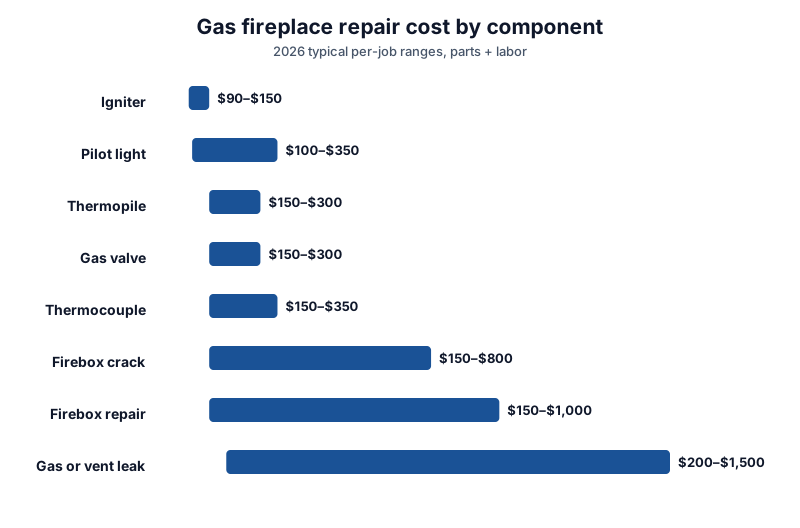
Source: HomeGuide 2026 fireplace repair cost data + Angi 2026 fireplace repair pricing. Costs include parts, labor, and one service call. Flue and smoke chamber repairs cost more because they're hard to access.
Fireplace Repair vs. Chimney Repair: Two Different Trades
This is the single most confused thing in fireplace bills - and calling the wrong trade wastes a trip fee and a week. Fireplace repair and chimney repair overlap visually but cover different parts of the system, with very different cost ranges.
| Category | Cost Range | What It Covers |
|---|---|---|
| Fireplace repair | $100-$2,000 | Firebox, gas components (pilot, thermocouple, valve), igniter, gas insert unit. Call a fireplace technician. |
| Chimney repair (minor) | $200-$850 | Flashing, cracks, chimney cap replacement. Call a chimney sweep/mason. |
| Chimney repair (extensive) | $500-$15,000 | Crown replacement, brick spalling, rebuilding, leaning stack. Masonry work. |
| Chimney cleaning + inspection | $150-$375 | Annual maintenance. Gas fireplaces need this too, even without soot buildup. |
A gas fireplace with a direct-vent or B-vent system has its own venting that's separate from a traditional chimney. If you have a gas insert in a wood fireplace, both the insert (fireplace repair) and the surrounding chimney (chimney repair) can need work independently. Diagnosing which one is the problem before calling saves a wrong-trade visit.
"Pilot Won't Stay Lit": The Gas Fireplace Diagnosis Ladder
A pilot that lights but won't stay lit is the single most common gas fireplace complaint - and the price climbs in a predictable order as you rule out each cause. Knowing this ladder stops you from approving a $300 gas valve replacement when a $150 thermocouple would have fixed it. The thermocouple shutting off gas is a safety feature, not a defect.
Step 1 - Igniter ($90-$150): If the pilot won't light at all, the igniter may be worn. The igniter uses electricity to spark the gas. A weak or dead igniter means no spark, no pilot. Cheapest fix.
Step 2 - Thermocouple ($150-$350): If the pilot lights but won't stay lit, the thermocouple is the usual culprit. It's the safety sensor that detects the pilot flame and keeps the gas valve open. When it fails, the gas valve shuts as a safety measure. This is the most common gas fireplace repair.
Step 3 - Thermopile ($150-$300): If the fireplace runs but won't respond to the thermostat, the thermopile may be bad. A thermopile is a cluster of thermocouples that generates enough electricity to power a thermostat - fireplaces with thermopiles can connect to wall thermostats. Thermocouple and thermopile failures have different symptoms.
Step 4 - Gas valve ($150-$300): If a new thermocouple and thermopile don't fix it, the gas valve itself may be bad. The valve controls gas flow - a faulty valve is a safety hazard (gas leak risk), so prompt replacement matters. Least common of the four.
Don't keep relighting: A pilot that won't stay lit is doing exactly what it's designed to do - shut off gas when it can't confirm the flame. Repeatedly relighting it fights the safety system. Replace the thermocouple instead.
Direct Vent vs. Vent-Free: It Changes Your Repair Bill
"Direct vent gas fireplace" gets nearly 10,000 searches a month because the vent type changes both installation and repair. Knowing which you have tells you what can fail and what a service call will cost.
Direct vent: A sealed combustion system that draws combustion air from outside and vents exhaust back outside through a coaxial pipe. No indoor air quality impact, safe for bedrooms/bathrooms, and the vent pipe itself can need repair ($200-$1,500 for a leak or joint failure). Most common modern gas fireplace type. Higher install cost, lower operating risk.
Vent-free (ventless): No vent pipe - combustion exhaust vents directly into the room. Cheaper to install, no vent repairs, but burns indoor oxygen and introduces moisture and trace combustion byproducts. Banned in some states and municipalities (California, New York City, Massachusetts). Requires a working CO detector in the room. Repair cost is lower (no vent system), but the safety trade-off is real.
B-vent (natural vent): Uses a traditional vent pipe that vents exhaust outside but draws combustion air from indoors. Older system, less efficient than direct vent. Repairs include both gas components and the vent pipe.
Which do you have? Direct vent fireplaces have a sealed glass front you can't open; vent-free units have an open flame with no glass seal; B-vent looks like a traditional fireplace with a vent pipe above. Knowing this before you call helps the tech bring the right parts.
Emergency & After-Hours Gas Fireplace Repair Pricing
A gas fireplace failing in peak winter is uncomfortable; a gas smell is the real emergency. Here's how timing and urgency change the bill.
| Call Timing | Premium | What You're Paying |
|---|---|---|
| Business hours, scheduled | No premium | Standard $75-$150/hr labor + trip fee. Best for cold-fireplace calls. |
| Same-day, business hours | Usually none | Priority scheduling, standard rates. Most fireplace companies offer this in winter. |
| After-hours / overnight | +$100-$250 | 1.5x-2x labor + emergency trip fee. Worth it for gas smell. |
| Weekend / holiday (peak winter) | +$150-$300 | Peak demand Nov-Feb. Limited crew; some book 5-10 days out. |
| Gas smell / leak (hazard) | Top of range | Shut off gas first, leave, call utility. You pay for fastest response. |
For a cold-fireplace call (no gas smell), waiting until business hours typically saves $100-$300. For a gas smell, shut off the gas and leave - don't wait for business hours.
What You're Paying For (on a $500 average repair)
| Component | % of Total | On $500 job |
|---|---|---|
| Parts (thermocouple, pilot, valve, igniter) | 20-30% | $100-$150 |
| Labor (diagnosis + repair) | 40-50% | $200-$250 |
| Service call / trip fee | 10-15% | $50-$75 |
| Overhead + profit | 10-15% | $50-$75 |
Gas fireplace parts are cheap ($15-$50 for a thermocouple) - most of the bill is labor and the service call. This is why a $30 part still costs $150-$350 to replace.
How Location Affects Your Cost
| Region | Labor | Materials |
|---|---|---|
| Mountain / high altitude | 1.2x | 1.05x |
| Northeast | 1.3x | 1.1x |
| Midwest | 1x | 1x |
| Southeast | 0.9x | 0.95x |
| West Coast | 1.4x | 1.15x |
To adjust: multiply the calculator's total by your region's average multiplier. Source: HomeGuide 2026 Regional Fireplace Cost Index + Angi 2026 fireplace repair data.
5 Factors That Change Your Gas Fireplace Repair Cost
1. Which part failed (the biggest driver)
An igniter is $90-$150 and takes 30 minutes. A flue repair can run $1,000-$7,000 and take days. The 70x range is why a diagnostic visit ($75-$150) before any repair quote is worth it. The good news: the most common gas fireplace failure (pilot won't stay lit) is usually a $150-$350 thermocouple - a mid-range, predictable fix.
2. Fireplace vs. chimney scope
If the problem is in the fireplace unit (gas components, firebox), you need a fireplace technician ($100-$2,000). If it's the chimney structure (flashing, crown, brick, flue liner), you need a chimney sweep or mason ($200-$15,000). Calling a fireplace tech for a chimney problem (or vice versa) wastes a trip fee and a week. Diagnose which one first.
3. Vent type (direct vent, vent-free, B-vent)
Direct vent fireplaces have a sealed glass front and a vent pipe that can need repair ($200-$1,500 for leaks). Vent-free units have no vent system to fail but introduce indoor air quality considerations. B-vent looks traditional with a vent pipe above. Knowing your vent type tells the tech what parts to bring and what can break.
4. Age and annual service history
A gas fireplace serviced annually ($150-$375) rarely has major failures before year 15. A unit that hasn't been serviced in 5+ years is a candidate for pilot, thermocouple, and gasket failures - the dust and wear accumulate. If you just bought a home with a gas fireplace and no service records, budget for an inspection and service in year one.
5. Season and timing
Gas fireplace repair demand peaks Nov-Feb. A thermocouple that costs $200 to replace in September can run $350+ in late December when every fireplace tech is booked. If the fireplace works but needs a tune-up, scheduling in the off-season (summer/early fall) saves $100-$300 and gets you faster service.
Red Flags When Calling Gas Fireplace Repair
- Quoting a gas valve replacement without testing the thermocouple: The pilot-won't-stay-lit ladder goes igniter → thermocouple → thermopile → gas valve. A tech who jumps straight to the gas valve is skipping the $150-$350 fixes. Ask which step they're on and why.
- Recommending chimney work without inspecting the fireplace unit: A "chimney problem" diagnosis without checking the gas components (pilot, thermocouple, valve) is incomplete. If your fireplace won't ignite, the issue is usually in the unit, not the chimney. Get a fireplace tech, not just a sweep.
- Pushing full fireplace replacement on a minor fix: A pilot, thermocouple, or igniter failure does not mean the fireplace is dead. Some techs upsell a $4,000 gas insert when a $200 thermocouple would restore heat. If the unit is under 12-15 years old, get a second opinion before replacing.
- No gas fireplace certification or license: Gas fireplace work requires a licensed professional (plumber or certified fireplace technician) in most states. Ask for the license number and verify online. Unlicensed gas work can void your homeowners insurance and create carbon monoxide risk.
- Cash-only or no written invoice: Reputable fireplace companies take cards and provide itemized invoices with parts, labor, and warranty terms. Cash-only with no receipt is a sign of an unlicensed operator - and any warranty claim becomes impossible.
- Not checking the venting on a direct vent unit: A direct vent fireplace's sealed combustion system is a safety feature. A tech who services the gas components but doesn't verify the vent pipe is intact is missing a leak risk. Insist on a vent inspection if you have a direct vent unit.
Price data sources: HomeGuide 2026 Fireplace Repair Cost · Angi 2026 Fireplace & Gas Fireplace Repair Pricing · U.S. CPSC Carbon Monoxide & Gas Appliance Safety Guidance · NFPA 211 Standard for Chimneys, Fireplaces, Vents (2026)
Last verified: July 2026
For broader industry benchmarks, see our 2026 construction cost statistics.
Frequently Asked Questions
How much does gas fireplace repair cost?
Gas fireplace repair costs $200 to $1,000 on average in 2026, with the broader fireplace repair range running $100 to $2,000 depending on the part. The most common gas fireplace fixes: igniter replacement ($90-$150), pilot light repair ($100-$350), thermocouple replacement ($150-$350), and gas valve replacement ($150-$300). Labor runs $75-$150 per hour plus a trip fee. Gas fireplaces cost less to repair than wood-burning fireplaces ($200-$2,000) because they don't accumulate soot or creosote, but their gas components (pilot, thermocouple, valve) fail periodically and need certified technician work - gas fireplace repair carries carbon monoxide and fire risk.
How much does it cost to replace a gas fireplace thermocouple or thermopile?
A gas fireplace thermocouple replacement costs $150 to $350; a thermopile replacement costs $150 to $300. The two parts are related but different: a thermocouple is a single sensor that detects the pilot flame and keeps the gas valve open - if it fails, the pilot won't stay lit. A thermopile is a cluster of multiple thermocouples that generates more electricity, enough to power a thermostat - fireplaces with thermopiles are more powerful and can connect to wall thermostats. If your pilot lights but won't stay on, the thermocouple is the usual culprit. If the fireplace runs but won't respond to the thermostat, the thermopile may be the issue. Both are cheap parts ($15-$50) - most of the cost is labor and the service call.
How much does it cost to fix a gas fireplace pilot light?
Gas fireplace pilot light repair costs $100 to $350 on average. If the pilot won't light at all, the igniter is often the problem ($90-$150 to replace). If the pilot lights but won't stay lit, the thermocouple is usually bad ($150-$350). If the pilot flame is weak or flickering, the pilot orifice may be dirty and need cleaning (often included in a $150-$375 annual service visit). A true pilot light assembly replacement runs $100-$350 including the part and labor. Don't keep relighting a pilot that won't stay lit - that's the thermocouple shutting off gas as a safety measure, and the fix is replacing the thermocouple, not fighting the pilot.
Is it worth repairing or replacing a gas fireplace?
Use the 50% rule: if the repair quote exceeds 50% of a new gas fireplace's cost ($1,900-$5,600 installed for a new fireplace, $2,000-$5,000 for a gas insert), replacement is usually the better long-term call. Gas fireplaces last 15-25 years with annual service. If yours is over 15 years old and needs a firebox repair ($150-$1,000) or repeated pilot/valve work, the next failure is often months away. Minor repairs on a fireplace under 10 years old (igniter, thermocouple, pilot, valve) are almost always worth fixing. Converting a wood fireplace to gas ($1,500-$8,000) or adding a gas insert ($2,000-$5,000) are common replacement-adjacent options if your existing wood fireplace is the one failing.
What's the difference between fireplace repair and chimney repair?
Fireplace repair and chimney repair are two adjacent but distinct trades with very different cost ranges. Fireplace repair ($100-$2,000) covers the firebox, gas components (pilot, thermocouple, valve), igniter, and the fireplace unit itself. Chimney repair ($200-$850 for minor jobs, $500-$15,000 for extensive) covers the chimney structure above the fireplace - flashing, crown, brick spalling, flue liner, and the chimney cap. A gas fireplace with a direct vent or B-vent system has its own venting that's separate from a traditional chimney. If you have a gas insert in a wood fireplace, both the insert (fireplace repair) and the surrounding chimney (chimney repair) can need work independently. Diagnosing which one is the problem before calling saves a wrong-trade visit.
How often should a gas fireplace be serviced?
Have a gas fireplace cleaned and inspected once per year, costing $150 to $375 for a combined cleaning and inspection, or $55 to $130 for an inspection alone. Gas fireplaces don't build up soot or creosote like wood-burning units, but annual service catches worn components (pilot, thermocouple, gaskets) before they fail mid-winter, cleans the burner and pilot assembly, and verifies the venting is intact. Skip annual service and you risk a cold fireplace on the first cold night - plus a service-call premium during peak winter demand. Many fireplace companies offer discounted annual service plans for regular customers; if you use the fireplace daily in winter, the plan usually pays for itself.
Does homeowners insurance cover gas fireplace repair?
Often partially. Most homeowners insurance policies cover chimney and fireplace damage if caused by a covered peril (fire, lightning, wind damage to the chimney, sudden impact). Normal wear and tear, age-related component failure (thermocouple, pilot, valve), and lack of annual maintenance are excluded - those are homeowner upkeep, not insurable damage. If a chimney fire, lightning strike, or falling tree damaged your fireplace or chimney, the repair may be covered minus your deductible ($500-$2,500). Many gas fireplace repairs ($100-$500) fall below a typical deductible anyway. Check with your provider - coverage varies, and some policies require proof of annual service to cover any fireplace claim.
Related cost guides
Gas fireplace, furnace, and water heater repairs all involve gas components and carry carbon monoxide risk. If you're weighing repairs across your gas appliances:
Are you a fireplace or HVAC contractor?
These guides are for homeowners. If you run a fireplace, chimney, or HVAC company and want to turn more service calls into booked jobs, these tools help with estimates, markup, and scheduling:
Browse All Cost Guides
See real 2026 pricing for 20+ home improvement projects - roof replacement, driveways, HVAC, plumbing, foundation, and more.
Browse All Cost GuidesMarcus Webb
Lead Reviewer & Construction Tech Analyst
Construction technology analyst focusing on estimating software. Marcus reviews 30+ estimating and project management tools, cross-checking official pricing, demos, and verified user feedback.
About Marcus →