Your AC dies on the first 95-degree Saturday of June. A tech shows up, replaces a $40 capacitor, and hands you a $325 bill. You just paid eight times the parts cost for a 40-minute visit — and honestly, that's a fair price.
That sentence confuses most homeowners, so let's fix it right now.
Most AC repairs in 2026 run $150–$650, with a national average around $375. Cheap parts, real labor. The bill isn't mostly parts — it's the licensed, insured, trained human standing in your yard with refrigerant gauges. This guide gives you the full 2026 price list by part, a breakdown of where your money actually goes (we pulled federal wage data most guides ignore), and the repair-or-replace math that uses your unit's age — not gut feel.
What AC Repair Actually Costs in 2026
Here's the range across every major pricing source we checked:
| Repair scope | Typical cost |
|---|---|
| Minor fix (capacitor, contactor, drain clog, thermostat) | $100–$400 |
| Common repair (fan motor, circuit board, refrigerant recharge) | $300–$800 |
| Major repair (evaporator coil, condenser coil) | $700–$2,700 |
| Compressor replacement | $1,000–$3,000+ |
| Emergency / after-hours service | adds $75–$300 |
Cross-checked across This Old House's 2026 pricing (built on Angi contractor estimates and Home Depot parts data), Fixr, and Angi's own HVAC guide. The numbers agree more than you'd expect: most sources land between $250–$700 for a typical repair call.
Now the part that actually matters to your wallet: which part failed. That single fact decides whether you're writing a $200 check or a $2,000 one.
AC Repair Cost by Part
| Part | What it does | Typical cost (parts + labor) |
|---|---|---|
| Drain line cleaning | Clears clogs that shut the system down | $80–$250 |
| Thermostat | Controls cooling calls | $100–$500 |
| Relay / contactor | Switches power to motors | $100–$450 |
| Capacitor | Starts the compressor and fans | $150–$400 |
| Circuit board | Runs system logic | $200–$800 |
| Fan motor | Moves air across coils | $300–$800 |
| Evaporator coil | Absorbs heat indoors | $700–$2,500 |
| Condenser coil | Releases heat outdoors | $1,000–$2,700 |
| Compressor | Heart of the system | $1,000–$3,000+ |
Data: This Old House 2026 (Angi contractor estimates + Home Depot parts pricing), updated March 2026.
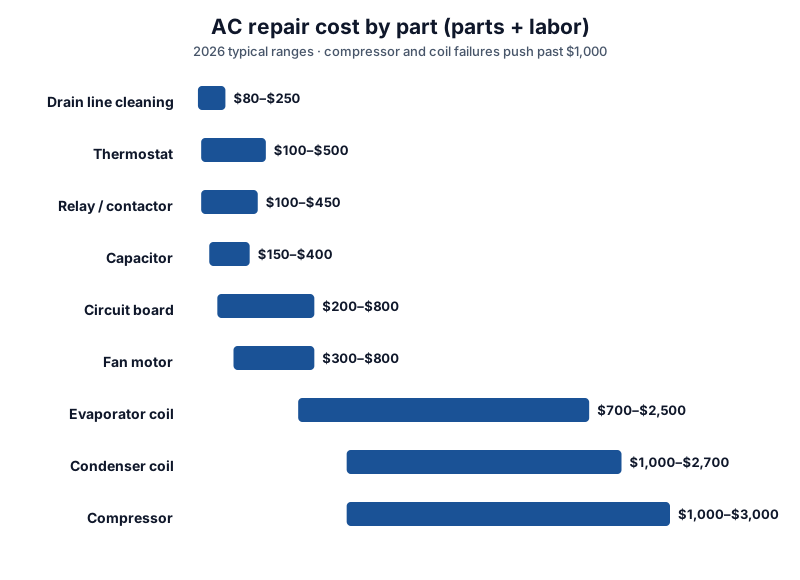
Notice the cliff between $800 and $1,000. Below it, you're fixing components. Above it, you're replacing the expensive organs of the machine — and that's where the repair-or-replace decision starts.
Refrigerant deserves its own mention. A simple recharge runs $200–$500. But if the system is losing refrigerant, you're paying for leak repair ($200–$1,500+) on top of the recharge — sealing a coil or line set is labor-intensive work. Any tech who recharges a leaking system without fixing the leak is selling you a repeat visit.
Why Your Bill Is 4x What the Tech Earns
That $375 average repair bill stings less once you see where it goes. Federal wage data makes this concrete.
The median HVAC technician earns $29.33/hour — and experienced techs at the 75th percentile earn $37.05 — according to the Bureau of Labor Statistics (OEWS May 2025, SOC 49-9021, 409,670 employed nationwide). Yet the customer-facing labor rate runs $100–$150/hour (industry-standard billing, per HomeAdvisor's 2026 pricing). That's a 3–4x gap, and it's not greed:
- Payroll burden — workers' comp, liability insurance, payroll taxes on every hour
- The truck — vehicle, fuel, $10K+ of tools and gauges, insurance
- The office — dispatchers, phone staff, software, overhead
- The drive — you're paying for windshield time between calls, not just your 40 minutes
- Warranty backstop — good companies eat the cost when a part fails again
(We broke the same wage-to-billing math down for every trade in our construction labor cost guide.)
Here's why this matters when you're comparing quotes: a solo handyman charging $60/hour carries no refrigerant license, no insurance, and no warranty. When the fix fails in August, he's gone. The $130/hour licensed contractor who warranties the repair for a year is the cheaper option the moment anything goes sideways.
The Diagnostic Fee, Decoded
Before any repair happens, you pay for the diagnosis: $75–$150 in most markets. Some companies credit it toward the repair if you proceed; others keep it no matter what. Ask which one you're dealing with before booking — it changes your comparison math.
Now the part nobody tells you. That fee buys a trained tech's time and test equipment, but what you do with the diagnosis is up to you. So:
Get the diagnosis in writing. Part name, failure reason, and the quoted fix on paper or text. Not "your unit needs work." If a tech can't or won't write it down, that's information too.
Beware the free-second-opinion hook. Some companies offer free diagnostics with your repair — then push replacement hard, because the equipment sale subsidizes the "free." A $2,500–$15,000 replacement quote (This Old House's 2026 range for central AC installed) needs to stand on its own numbers, not on a waived $99 fee. If the "free" opinion ends with a compressor replacement pitch for your 9-year-old unit, get one paid, independent quote before signing anything.
Time of year moves the price. July callbacks compete with a hundred other dead ACs; April tune-up season doesn't. Same part, same labor — different demand curve. (More on timing below.)
Repair or Replace: The Actual Math
You've probably heard the 50% rule: if a repair costs half of what a new unit costs, replace. It's directionally right but useless in the moment, because nobody knows what "half" means mid-July with a dead compressor.
Here's the version you can actually use. Run your unit's age × repair cost — if it exceeds $5,000, replacement wins (this heuristic traces to This Old House's 2026 guidance, and it matches what the numbers show). Then layer in these two checks:
First, the failure pattern. Compressors and coils cost $1,000–$3,000 to fix and take the rest of the system down with them as they age. A $400 capacitor on the same 12-year-old unit is routine maintenance — capacitors die on every system eventually.
Second, the warranty math. If the manufacturer's parts warranty (commonly 10 years on the compressor with registration) still covers the failed part, you're paying labor only — often $300–$600 for a $1,500 part. That flips a "replace" call back to "repair" instantly. Check your warranty before you approve anything.
Put together, here's the decision grid:
| Your unit's age | Fix under $300 | Fix $300–$1,000 | Compressor / coil ($1,000+) |
|---|---|---|---|
| Under 8 years | Repair | Repair | Repair — check parts warranty first |
| 8–12 years | Repair | Your call — get 2 quotes | Run the age × cost math, lean replace |
| 12+ years | Repair | Lean replace | Replace |
One more data point for the 12+ row: units this old still running pre-2020 R-22 refrigerant are effectively unfixable for leaks — R-22 production was banned in 2020, and remaining stock costs several times what R-410A costs per pound. A leaking R-22 system is a replacement decision whether you like it or not.
The 5-year reality check. Say your 12-year-old, 2,000 sq ft home's compressor dies. Repair: roughly $1,500–$2,500, and you're still running a 12-year-old machine where the fan motor ($300–$800) and circuit board ($200–$800) are next in line. Replace: about $7,500 for a 14.3 SEER2 system at that size (This Old House 2026 pricing) — with a full parts warranty and lower summer bills from the efficiency jump. If the rest of the system has 3–5 good years left, repair wins. If you've already replaced the capacitor and the fan motor in two years, you're paying to keep a machine on life support.
New to shopping for a replacement? Our AC installation cost guide breaks down equipment tiers, and if you're weighing a heat pump instead of straight cooling, the heat pump cost calculator shows where those numbers land in 2026.
What Pushes the Bill Up (or Down)
- Season. Peak-summer emergency calls stack the after-hours premium ($75–$300) on top of parts. The identical repair in April or October often costs noticeably less — techs are chasing work, not queuing it.
- Access. A condenser on a ground-level pad is a 40-minute swap. A rooftop package unit or a tight crawlspace coil adds real hours.
- Warranty status. Parts covered = you pay labor only. This is the single biggest swing factor, worth checking before any quote call.
- System type. Ductless mini-splits and packaged units carry different part prices than standard split systems ($250–$900 and $300–$900 for common repairs vs $150–$650 for central AC, per This Old House's 2026 tables).
How Contractors Price These Jobs
Flipping to the other side of the invoice for a second, because it helps you read quotes better.
Contractor forums are full of the same confession: new business owners lose money on repairs because they forget the drive time, the insurance, and the parts markup they'll need next month. The result you see as a homeowner is a huge spread between quotes — the tech with the $450 capacitor quote may be covering a licensed operation, and the $250 quote may be a guy with a van and a prayer.
If you run an HVAC business yourself, the fix is boring: a real cost database and a quote template. Our guide to estimating HVAC jobs walks the full pricing workflow, and the best HVAC estimating software comparison covers tools that keep repair quotes consistent instead of guessed.
How to Pay Less (Without Gambling on the Repair)
- Book in the shoulder season. April–May and September–October. Same techs, same parts, thinner schedule book.
- Get three quotes on anything over $1,000. Below that, one licensed opinion plus the written diagnosis is enough. Above it — especially compressor/coil territory — the spread between quotes routinely pays for the extra phone calls.
- Ask for the maintenance-plan rate. Many companies discount diagnostics and labor 10–15% for plan members (ask for the specific number, not "we offer discounts"). At $15–$30/month with an annual tune-up included, it can pay for itself in one avoided emergency call.
- Replace filters monthly in cooling season. It's the cheapest insurance in HVAC. Restricted airflow overheats components and manufactures exactly the failures in the table above.
And one more on those "free inspection" postcards: a real inspection checks refrigerant pressures, capacitor readings, and drain flow. If the "inspection" is five minutes and ends in a replacement quote, you've been marketed to. You now know the part prices — make them itemize.
Frequently Asked Questions
How much does AC repair cost in 2026?
Most repairs land between $150 and $650, with a national average around $375. Minor fixes (capacitor, drain line, thermostat) run $100–$400; major component work (compressor, coils) runs $1,000–$3,000+. Emergency service adds $75–$300 depending on timing.
Is it worth repairing a 15-year-old AC unit?
For cheap fixes under $300, often yes — a new capacitor buys you another season. For compressor or coil failures, no: the repair costs $1,000–$3,000 on a machine past its 12–15 year design life, and other components are aging alongside it. Age × repair cost over $5,000 means replace.
Do HVAC companies waive the diagnostic fee if you repair?
Some do, some don't — it varies by company, not by industry rule. Ask before booking. A $99 fee credited toward a $400 repair is a $99 discount; the same fee kept anyway is just the cost of the diagnosis.
Why is AC repair so expensive?
Because you're paying for a licensed, insured technician's overhead, not just 40 minutes of work. The tech's median wage is $29.33/hour (BLS, May 2025), but the billing rate of $100–$150/hour also covers the truck, insurance, dispatch, drive time, and the warranty behind the repair.
How much does it cost to recharge AC refrigerant?
A straightforward recharge runs $200–$500. If the system has a leak — and low refrigerant usually means it does — leak repair adds $200–$1,500+ because sealing coils or line sets is labor-heavy. And if your unit runs pre-2020 R-22 refrigerant, recharge costs multiply several times over due to the production ban.
Can I repair my own AC?
You can safely swap filters, clear debris around the condenser, and flush an accessible drain line. Everything else — capacitors, refrigerant, electrical work — belongs to a licensed tech. Refrigerant handling legally requires EPA Section 608 certification, and DIY mistakes on pressurized, high-voltage equipment cost far more than the service call.
The Bottom Line
Most AC repairs are cheap and worth it: sub-$800 fixes on units under 10 years old are routine maintenance, not money pits. The decisions that actually cost you are the $1,000+ calls on older systems — and those deserve the written diagnosis, the warranty check, and a second quote before you sign.
If your repair fits the "replace" box in the grid above, don't wait for the next breakdown to start shopping. Shoulder-season replacement quotes are cheaper, and you'll pick equipment on merit instead of desperation.
Repair small things fast, price big things twice, and never let a July emergency make the decision for you.