You measured the roof, ordered the shingles, and halfway through the job your crew ran short. Or you landed the job, finished it, and the profit wasn't there. Both trace back to the same place: the estimate.
Here's the good news: a roofing estimate isn't guesswork. It's a short chain of numbers - squares, pitch, waste, labor, overhead - and every link is checkable.
In this guide, we'll walk one real roof all the way from a tape measure to a final price. You'll get the pitch multiplier table most competitors skip, a waste-factor tier chart, and a pre-bid checklist for the things that quietly eat roofing profit.
Let's dive in.
The Whole Estimate at a Glance
Before the steps, here's where we're headed. This is a real worked example: a 1,600 sq ft footprint gable roof with two valleys, a 6/12 pitch, architectural shingles, one layer tear-off.
| Step | Number | Result |
|---|---|---|
| Footprint | 1,600 sq ft | Ground or plan measurement |
| Pitch multiplier | 6/12 = 1.118 | Converts flat area to roof surface |
| Roof surface | 1,789 sq ft | 1,600 × 1.118 |
| Squares | 17.9 → 18 squares | Divide by 100 |
| Waste factor | 15% (cut-up roof) | 18 × 1.15 = 20.7 → order 21 squares |
| Bundles | 63 | 3 bundles per square |
| Labor | 40-60% of job price | Check against local roofer wages |
| Overhead + profit | Your markup on top | Convert margin to markup correctly |
Every number in that table comes from a step below. Once you can reproduce this chain on your own roof, you can estimate any asphalt shingle job in under 20 minutes.
One safety note before we start: roof work is high work, and estimates that ignore fall protection and crew safety aren't cheap - they're liabilities. We'll flag the estimate-related pieces as we go.
Step 1: Measure the Roof and Count Squares
Roofing has its own unit, and mixing it up is the fastest way to look like an outsider.
1 square = 100 square feet of roof surface. Quotes, material orders, and labor pricing all run in squares - not square feet. A 24-square roof is 2,400 sq ft of surface, and nobody in the industry calls it that. Say "24 square."
You have two ways to get there:
- Walk the roof. Measure each plane's length and width, multiply, and add the planes together. Most accurate, and it lets you count valleys, hips, and penetrations up close.
- Measure the footprint. Measure the house's ground dimensions, then convert flat area to roof surface with the pitch multiplier. Faster, a bit less precise, and the standard starting point for most estimates.
Here's what most people don't know: the footprint method only works if you convert for pitch. A flat 1,600 sq ft footprint is never 16 squares - it's 16 squares times whatever the slope adds.
The Pitch Multiplier Table
The multiplier is the trigonometry of your roof: for every 12 inches horizontal, the roof rises the first number. A 6/12 pitch rises 6 inches per foot of run.
| Pitch | Multiplier | Walkability |
|---|---|---|
| 2/12 | 1.014 | Low slope - special underlayment rules |
| 3/12 | 1.031 | Walkable |
| 4/12 | 1.054 | Walkable |
| 5/12 | 1.083 | Walkable |
| 6/12 | 1.118 | Walkable, most common residential |
| 7/12 | 1.158 | Walkable, starts slowing crews |
| 8/12 | 1.202 | Borderline - staging costs appear |
| 9/12 | 1.250 | Steep - slower, more labor |
| 10/12 | 1.302 | Steep - roof jacks and extra labor |
| 12/12 | 1.414 | 45° - premium pricing territory |
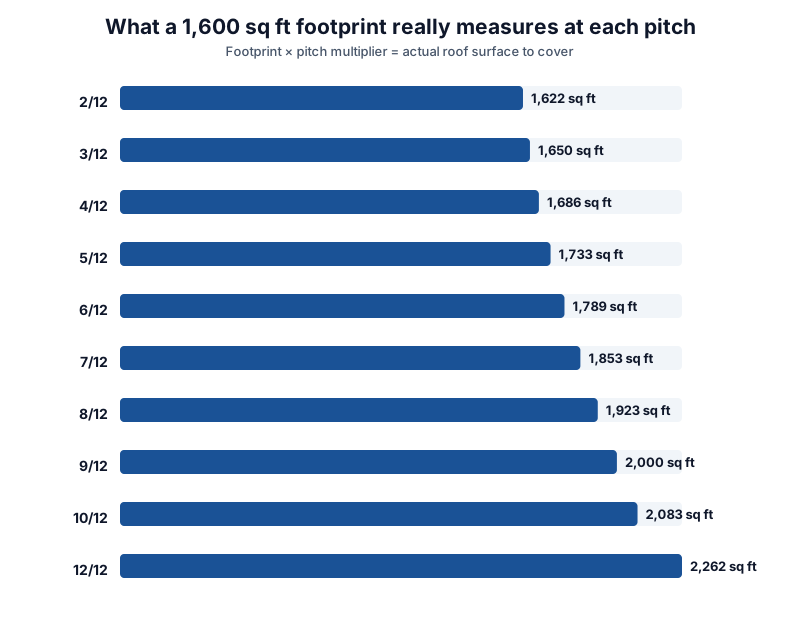
Two things this table should tell you besides the math:
- Below 2/12, asphalt shingles aren't your product. Manufacturers require special underlayment systems on low slopes (2:12 to 4:12), and below 2:12 the roof needs a membrane system like TPO or EPDM - a completely different estimate.
- Steepness prices into labor, not just area. An 8/12 roof isn't just 8% bigger than its footprint - it's slower to work, which shows up later in the labor line.
Don't want to do the geometry by hand? Enter your footprint and pitch into our roof area calculator and it returns the surface area in both square feet and squares.
Step 2: Set the Waste Factor
Waste factor is the extra material you order to cover cuts, starter courses, ridge caps, and the mistakes that happen 20 feet in the air. Too low, and your crew is driving to the supplier mid-job. Too high, and you're eating returns fees or handing the customer a padded bill.
Common industry practice groups roofs into tiers:
| Roof type | Typical waste factor |
|---|---|
| Simple gable, no valleys, open layout | 10% |
| Hip roof (four slopes, more cuts) | 15% |
| Cut-up roof: valleys, dormers, skylights | 15-20% |
| Complex roof or starter + hip/ridge stock included | 20%+ |
Here's where it gets interesting: waste isn't just about geometry. Three more things move the number:
- Material type. Asphalt shingles waste less - they cut clean and forgiving. Metal panels and tile waste more, because panel layout and pattern matching punish every cut.
- Crew experience. A green helper burns more material than a 10-year installer. If you're running apprentices, bias the tier upward.
- Steepness. High-pitch roofs drop and damage more bundles during handling. Plan for it.
Back to our example: the 18-square roof has two valleys, so it lands in the cut-up tier. 18 × 1.15 = 20.7, and you round up to 21 squares ordered.
The result? You ordered 3 extra squares for a roof that measures 18. That's not padding - that's the difference between finishing Friday and sending a crew back Monday for two bundles the supplier no longer stocks in that color.
Step 3: Build the Material List
Shingles are the headline, but they're maybe two-thirds of the material story. A complete asphalt shingle order includes:
- Field shingles: 21 squares × 3 bundles = 63 bundles (most three-bundle shingles cover roughly a third of a square each - verify on the wrapper, packaging varies by product line)
- Starter strip and hip/ridge cap: measured in linear feet - run a tape along your eaves, rakes, and ridges, then check the coverage printed on the product
- Underlayment: most synthetic rolls cover about 10 squares, so 21 squares needs at least 3 rolls
- Ice and water shield: self-adhering membrane at eaves and valleys. In cold climates, code (IRC, as adopted locally) requires it along the eaves extending past the interior wall line - check your local version
- Drip edge: eaves plus rakes, in linear feet
- Flashing: step flashing wherever the roof meets a wall, valley metal in the valleys, and new flashing at chimneys and skylights
That last line deserves its own warning: most manufacturers and standard practice call for new flashing at every penetration - reused flashing is a callback waiting to happen, and some jurisdictions restrict reusing it at all. Flashing failures are the most common leak source in the trade, so this is one line item you never value-engineer away.
Material pricing changes fast. Ask your supplier for a current sheet, and put a validity window on the quote you send out. The 2026 State of the Industry report from Roofing Contractor Magazine found 38% of contractors named rising material costs a top concern, so quoting from last season's sheet is a real profit leak, not a hypothetical.
Step 4: Price the Labor
Labor is the line where roofing estimates go to die, because it's the hardest to verify from an armchair.
Start with the structure: in typical roof replacement work, installation labor runs roughly 40-60% of the total job price, with materials making up the rest. If your labor line falls way outside that band, something upstream - your squares, your waste, your scope - probably needs a second look.
Then sanity-check against real wages. The BLS tracks roofers (SOC 47-2181) at a median of $24.05 an hour nationally (BLS OEWS, May 2023) - but geography swings that number hard:
| Location | Average roofer wage |
|---|---|
| Massachusetts | $34.80/hr |
| Illinois | $33.71/hr |
| California | $33.17/hr |
| Florida | $22.61/hr |
That's a 50%+ spread between the highest- and lowest-wage major states. In storm-heavy markets like Florida, post-hurricane demand can push local labor pricing even further from the national picture. So don't copy a per-square labor number from a national article - anchor your labor line to your own loaded crew cost instead. The full method - wage, payroll burden, overhead - is in our labor cost guide.
Here's the surprising part: the pitch you already calculated in Step 1 also prices your labor. A walkable 5/12 roof and a 10/12 roof with identical surface area aren't the same job - staging, harnessing, and slower production all show up in the hours. Same with tear-off: every extra layer of old shingles adds disposal and time before the first new bundle goes down.
Step 5: Add Overhead and Profit
You now have materials and labor. What's left is everything that keeps the business alive - insurance, trucks, office time, the quotes you lost - plus your profit.
In the trades, this trips more contractors than any other math: markup and margin are two different denominators. A 30% markup on cost only banks a 23% margin on price. On a $10,000 roof, that difference is about $1,286 - and across 50 jobs a year, it's $64,000.
The conversion table and the reasoning are in markup vs. margin explained. If you take one thing from this section: decide the margin you need to survive, convert it to a markup number before you bid, and never bid "30% because that sounds normal."
Roofing margins commonly run in the 10-20% range, adjusted for risk - a steep, cut-up, two-story job with tight access carries more risk than a walkable single-story, and the price should say so.
Step 6: The Pre-Bid Checklist
Before any roofing number leaves your office, check the things that turn a winning bid into a losing job:
- Tear-off layers. Peek at the edges or check records. Two layers means double the disposal and disposal fees - and an old cedar shake layer under modern asphalt is the expensive version of this surprise.
- Deck condition. You're pricing shingles, but if the sheathing is soft, you're pricing replacements per sheet. Decide in advance what you charge for deck repair and put it in the contract as a unit price.
- Access. Tight alleys, no driveway, power lines over the drop zone - each adds setup time and each is invisible in the squares count.
- Wind rating and code items. In high-wind regions, code expects shingles rated per ASTM D7158 (Class D/G/H) - the rating is printed on the wrapper, and a sales pitch about "130 mph shingles" isn't a substitute for the label. Ice and water shield coverage is likewise a code line item, not an upsell.
- Permits and disposal. Permit fees vary by jurisdiction, and dumpster or dump fees scale with layers and squares. Both belong in the estimate as line items.
- Storm damage work. If insurance is involved, expect the adjuster's number to differ from yours - commonly by 30-50% in storm markets, because adjuster software prices depreciation differently from replacement cost. Get coverage questions resolved with the homeowner's carrier before work starts, and never let anyone sign a contract before the claim is assessed.
And one more: if the homeowner asks you to match a suspiciously low bid from an out-of-town crew that showed up after the last storm, that's not a pricing problem. Storm chaser pricing skips the insurance, the permits, and the warranty - which means your honest number was never going to match it, and shouldn't.
Frequently Asked Questions
How do I calculate roofing squares from square feet?
Divide roof surface area by 100. Measure each plane (or footprint × pitch multiplier), total the square footage, and divide by 100. A 2,200 sq ft roof surface is 22 squares. Order materials in squares - suppliers price and bundle shingles that way.
What pitch multiplier should I use?
Match your pitch: 4/12 is 1.054, 6/12 is 1.118, 8/12 is 1.202, 12/12 is 1.414. Multiply your flat footprint by the multiplier to get roof surface area. The full table is in Step 1 above, and our roof area calculator runs the math for you.
How much waste factor should I add?
Start at 10% for a simple gable, 15% for a hip roof, and 15-20% for cut-up roofs with valleys, dormers, or skylights. Then adjust for material (metal and tile waste more), crew experience, and steepness. Ordering a couple of extra bundles beats stopping the job mid-week.
How much does a square of roofing cost installed?
It varies a lot by material and region - national roof replacement averages run about $6,000-18,000 for typical homes (see our roof replacement cost guide). Rather than memorizing a per-square number, build your own: materials from your supplier sheet, labor from your crew cost, overhead and profit on top. Our roof replacement cost calculator gives you a regional starting point.
Do I charge more for steep or high roofs?
Yes. Steepness slows production, requires more staging and safety equipment, and raises risk. Most shops add a steep-rope premium somewhere above 8/12 - price it as labor hours, not a flat guess. The pitch multiplier table shows where walkability breaks down.
Should I include insurance work in my estimates differently?
Yes - with clear eyes. Insurance work gets negotiated against the adjuster's scope, which often runs 30-50% below a contractor's replacement-cost estimate in storm markets. Price your real scope, document supplement items (code upgrades, ice and water shield, steep charges), and keep the homeowner's carrier in the loop before work starts.
How long should it take to estimate a roofing job?
With a repeatable process - footprint, pitch multiplier, waste tier, material sheet, labor rate, markup conversion - under 20 minutes for a typical residential roof. Aerial measurement services can cut the measurement step further, but the pricing chain is still yours to own.
Last updated: September 8, 2026. Wage data from the U.S. Bureau of Labor Statistics (OEWS, May 2023). This guide covers estimating practice; roof work is hazardous - follow fall protection requirements and local codes, and consult a licensed contractor for site-specific advice.
Want to speed the whole chain up? See our roofing estimating software rankings for the tools we rank that handle squares, waste, and pricing in one place - or run your next bid through the roof replacement cost calculator.