Most deck estimates fall apart the same way: the decking math is right, and everything around it is wrong.
Railing, stairs, footings, hardware. Each one is small on its own. Together they run 35–45% of a deck's materials bill — and they're the four items contractors forget to price when the bid goes out Friday and the customer signs Monday.
Here's the good news: deck estimating is one of the most learnable estimating jobs in construction. Five dimensions, a price list, and a repeatable order of operations.
In this guide, you'll get the full 5-step method plus a complete worked example — a 12×16 pressure-treated deck, every line item priced, landing at $5,125 in materials and soft costs. Decking is only 21% of that. The other 79% is where deck bids go to die. Let's dive in.
Step 1: Price the Decking Boards (With the Waste Factor)
Decking is the only part of the estimate most people get right. The number comes from three inputs: deck area, board coverage, and waste.
Take your deck area in square feet. Divide by one board's effective coverage — the face width plus half the gap. A 5/4×6 pressure-treated pine board measures 5.5" across the face, and with a 1/8" gap, one linear foot covers about 0.47 sq ft of deck.
For a 12×16 deck (192 sq ft):
- 192 ÷ 0.47 ≈ 410 linear feet of board
- Add 10% waste for field cuts and defects: ~450 linear feet
- At $2.40 per linear foot (5/4×6 PT pine, big-box pricing): ~$1,080
Two things wreck this step. First, running boards parallel to the long side instead of the short side changes nothing in area but changes every cut. Second, diagonal layouts add 15% waste, not 10% — price them differently or eat the difference.
While you're here, check your framing spacing before you commit to 5/4 boards. Joist spacing and decking thickness have to match — 16" on center works for 5/4 wood, but composite usually needs 12". If you're not sure what your frame allows, our deck joist span calculator runs the span and spacing math per board size.
Step 2: Price the Frame — Joists, Beams, and Posts
The frame is where deck estimates drift, because lumber prices move and crew habits differ. Work top-down:
- Beams. A 12-ft-wide deck with joists spanning ~10 ft wants a doubled 2×10 beam. Two beams at 16 ft: ~64 linear feet of 2×10 PT.
- Joists. 16" on center across a 12-ft width: 10 joists at 16 ft, plus rim joists around the perimeter. That's 160 + 56 = ~216 linear feet of 2×8.
- Posts. Six 6×6 PT posts at 8-ft beam spacing: 6 × 4 ft exposed = 24 linear feet, plus offcut allowance.
At 2026 big-box pricing (2×8 PT ≈ $4.30/lf, 2×10 PT ≈ $5.60/lf, 6×6 PT ≈ $9.50/lf):
| Frame item | Quantity | Price | Line total |
|---|---|---|---|
| 2×8 joists + rims | 216 lf | $4.30/lf | $929 |
| 2×10 beams (doubled) | 64 lf | $5.60/lf | $358 |
| 6×6 posts | 28 lf | $9.50/lf | $266 |
Frame subtotal: ~$1,553. Add 5% for the cuts that go wrong and you're carrying $1,630.
Here's the thing: joist spacing decisions cascade. Moving from 16" to 12" on center adds two joists and about $70 — but it also lets you use thinner decking, which can save more than that. Decide the frame and the decking together, not separately.
Step 3: Price Footings and Hardware (The Items That Kill Margins)
Now the part under the deck. Footings and hardware are ~12% of this build's material cost, and they're the most commonly forgotten line in deck bids.
Footings. Six 6×6 posts on a 12×16 deck need six footings. The standard residential detail is a 12" sonotube set below frost line, filled with concrete. Bags run $6–8 apiece; each footing takes 4–5 bags plus a cardboard tube at ~$9. Budget ~$290 for all six. Depth and diameter requirements vary by county and soil — our deck footing calculator sizes the footing and footing spacing for your deck dimensions and frost line.
Hardware. This is the line item that turns a $500 profit into a $90 one. Count it, don't guesstimate:
- Joist hangers: 10 joists × 2 ends × 2 rims = 40 hangers at ~$1.40 → $56
- Structural screws and joist screws: ~$95
- Post-to-beam connectors and through-bolts: ~$48
- Concrete anchors and post bases: 6 × $11 → $66
Hardware subtotal: ~$265.
But here's the kicker — this is also where code hides. Guardrail post hardware, ledger flashing, and hold-downs all get inspected. Miss one and the correction costs a return trip, not a trip to the truck.
Step 4: Price Railing and Stairs (Where the Money Really Is)
Railing and stairs together are ~30% of the materials bill on this deck — nearly as much as the frame. Yet they're the two items most often priced "by feel."
Railing. Perimeter is 56 linear feet. Subtract the stair opening (~4 ft): 52 lf of rail. A pressure-treated rail kit — top cap, balusters, bottom rail, posts — runs $18–25 per linear foot at 2026 prices. Take the middle: 52 × $21.50 = ~$1,120.
Baluster spacing is code, not preference. Most jurisdictions cap gaps at 4 inches, measured differently than people assume — our deck railing spacing calculator returns the exact baluster count per section so you buy the right number the first time.
Stairs. A 30-inch deck height means 4–5 risers. Stringers, treads, and riser material for one 4-ft-wide run: ~$310. If the customer wants a landing or a second run, price it as its own mini-estimate — stair runs multiply fast.
The pattern to notice: rail and stairs are priced per linear foot and per run, not by deck area. Estimate them separately every time, and your bids stop bleeding here.
Step 5: Add Permit, Cleanup, and the Markup You Actually Need
Here's the deal: three lines left, and they're the difference between a bid and a guess:
- Permit. Most counties require one for any attached deck over 30 inches. Fees run $150–400 depending on jurisdiction. Price it even when the customer pulls the permit — if they forget, it's your schedule that slips.
- Cleanup and disposal. Offcut haul-away and dumpster share: ~$180 for a build this size.
- Overhead and margin. Add your overhead percentage, then margin — calculated on the right base. If you markup when you should margin (or the reverse), the error compounds silently on every bid. We break down the difference in markup vs margin for contractors.
The Full Worked Example: 12×16 Pressure-Treated Deck
Every number above, assembled into one estimate. Deck: 192 sq ft, 30 inches off grade, one 4-ft stair run, 52 lf of rail, PT lumber throughout.
| Line item | Cost |
|---|---|
| Decking boards (450 lf 5/4×6 PT) | $1,080 |
| Frame lumber (joists, beams, posts) | $1,630 |
| Footings (6 sonotubes + concrete) | $290 |
| Hardware and connectors | $265 |
| Railing (52 lf) | $1,120 |
| Stairs (1 run, 4 ft) | $310 |
| Permit (mid-range) | $250 |
| Cleanup and disposal | $180 |
| Materials + soft costs total | $5,125 |
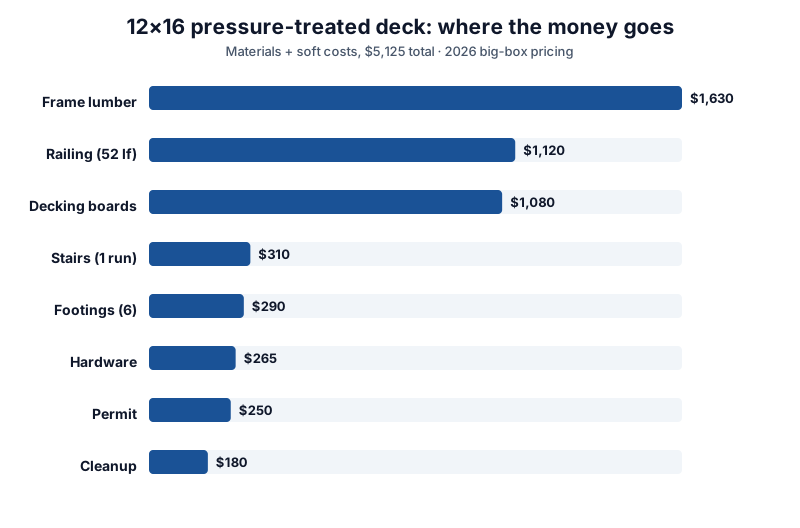
Look at where the weight sits. Decking — the part everyone prices carefully — is 21% of the bill. Railing, stairs, footings, and hardware add up to $1,985, or 39% of the total. Those four lines are what area-based estimates miss, and they're why deck bids leak margin.
Labor, if you're pricing turnkey: installed PT decks in 2026 run roughly $30–55 per square foot all-in, which puts this deck at $5,800–10,500 installed. Against $5,125 in materials and soft costs, that's a labor-plus-margin envelope of $675–5,375 depending on your region and crew rate — our labor cost guide walks the rate math.
And the visual version — this is where deck bids actually go:
Here's what most people don't know: composite changes this math more than any other single decision. Composite decking runs $8–12 per square foot versus $3–4 for PT — the same 192 sq ft deck jumps to $7,300–9,700 in materials alone, and framing often needs tighter joist spacing to carry it. Price both before you quote "options" to the customer.
When to Move Past Hand Estimating
A 12×16 PT deck is five steps and a spreadsheet. You can absolutely run this method in Excel, and for a builder doing a dozen decks a year, that's a legitimate answer.
The breakpoint is repetition and variation. If you price decks weekly — mixed materials, multiple stair configurations, customer-changeable options — template-based estimating software pays for itself in turnaround time. Projul and Clear Estimates both handle deck line-item templates; our best estimating software guide sorts the current tools by crew size and trade.
The deck calculators on our site cover the four trickiest sub-calculations — footings, joist spans, railing spacing, and stairs — free, no signup.
Frequently Asked Questions
How much does it cost to build a 12×16 deck?
Materials and soft costs for a pressure-treated 12×16 deck run about $5,000–5,500 using 2026 big-box pricing, as worked through in this guide ($5,125 in the worked example). Installed by a contractor, expect roughly $5,800–10,500 depending on region, site access, and railing choices. Composite decking adds $2,000–4,500 to the material line.
How do I calculate decking boards for a deck?
Divide deck area by one board's effective coverage per linear foot (a 5/4×6 board covers about 0.47 sq ft per linear foot with a 1/8" gap), then add 10% waste — 15% for diagonal layouts. A 192 sq ft deck needs roughly 450 linear feet of 5/4×6 decking.
What do most deck estimates forget?
Four items: railing, stairs, footings, and hardware. On the worked example above they total $1,985 — 39% of the full materials-and-soft-costs bill. Bids priced from deck area alone miss nearly all of it.
Do I need a permit to build a deck?
Most US jurisdictions require a permit for attached decks above 30 inches or over a certain size threshold — the rules vary by county. Fees typically run $150–400. Pull the local requirement before you bid, because inspection corrections cost schedule, not just money.
How much should I charge for deck labor?
Installed deck pricing in 2026 runs about $30–55 per square foot for pressure-treated builds. Back out your materials and soft costs first, then price labor from your crew's hourly rate plus overhead — the billing-rate math is in our labor cost guide.
Is composite decking worth the extra cost?
It's worth it for low-maintenance customers and 20-year holds, not for maximum square footage per dollar. Composite runs $8–12 per square foot of decking versus $3–4 for PT, and often forces tighter joist spacing that adds frame cost. Quote both ways and let the customer's timeline decide.
The Bottom Line
Deck estimating is five steps: decking, frame, footings and hardware, rail and stairs, then permit and margin. The worked example above — 192 sq ft, PT throughout — lands at $5,125 in materials and soft costs, and 39% of that number lives in the four items area-based bids forget.
Run the method once on your next bid, line by line. The second deck you estimate will take half the time of the first.
Material prices are 2026 big-box list prices and vary by region — verify against your supplier's current sheet before bidding. Installed-cost ranges reflect typical 2026 US pricing for pressure-treated decks.