Crawl space mold removal quotes are all over the map — $500 for a surface cleanup, $4,000 for a full professional job, $8,000+ once containment and structural drying get involved. The published national average sits at $2,368 (SERVPRO, 2026), and most full-service jobs land between $1,500 and $4,000.
If you bid this work, the gap between a $1,800 job and a $4,500 job usually isn't the mold. It's access, containment, and whether you priced the moisture fix that keeps it from coming back.
This guide gives you the 2026 price bands, the actual wage data for the techs doing the work (straight from BLS, May 2025), and the line items that make your quote defensible when a homeowner is comparing you against two other trucks.
What Crawl Space Mold Removal Costs in 2026
The published ranges agree on the shape, even when the endpoints differ:
| Scenario | 2026 cost | Source |
|---|---|---|
| Small surface cleanup (visible mold, no demolition) | under $500 | This Old House, 2026 |
| Crawl space cleaning including mold removal | $500 – $4,000 | HomeGuide, 2026 |
| Full-service removal, national average | ~$2,368 | SERVPRO, 2026 |
| Professional remediation with containment | $1,500 – $4,000 | Palm Build Restoration, 2026 |
| Severe cases (deep saturation, structural drying) | $1,500 – $8,000 | HomeRestorationCosts, 2026 |
| Crawl space encapsulation (the upsell) | $1,500 – $15,000 | Angi, 2026 |
Three things move a job from the $500 row to the $8,000 row, and none of them are the mold itself: how hard the space is to work in, how much material has to come out, and whether the moisture source gets fixed during the same visit.
Here's where it gets interesting: the labor cost of the crew touching that mold is lower than almost any other trade you compete against. We'll get to the numbers in a minute.
Why Quotes for the Same Crawl Space Vary 3x to 8x
A homeowner in the waterproofing forums described the problem perfectly. Three companies inspected the same damp basement and came back with $6,500, $9,200, and $14,800 — three different scopes, no way to compare. Crawl space mold quoting works the same way, and if you can't explain the spread, the customer assumes the highest number is a scam.
The spread usually comes from four honest differences:
- Access class. A 3-foot crawl with a intact vapor barrier is a different job from an 18-inch crawlspace with standing water and collapsed insulation. Confined-space work adds setup time on every single trip in and out.
- Removal method. HEPA vacuuming and sanding treated studs is cheap. Soda blasting or wire-brushing heavy colonization is 3-4x the labor hours.
- What gets torn out. Saturated fiberglass insulation and damaged vapor barrier have disposal costs — and moldy insulation can't be cleaned, only replaced.
- Whether the water problem gets fixed. A quote that ignores the downspout discharging next to the foundation is a quote for mold that comes back in six months.
The second scenario that burns homeowners — and your reputation — is the scope-expansion trap. One family in the foundation threads paid about $15,000 for waterproofing, then discovered mold behind the finished wall afterward: another $3,000 for remediation, more for demolition and rebuild, pushing the total toward $30,000. On crawl space jobs, the same trap shows up as "we opened the vapor barrier and found..." Your defense is photo documentation at inspection and a quote that lists what happens if the scope grows.
The Labor Math Most Contractors Never Run
Mold remediation technicians fall under BLS SOC 47-4041 — Hazardous Materials Removal Workers, the same classification as asbestos and lead abatement. We pulled the full May 2025 wage distribution straight from the BLS API:
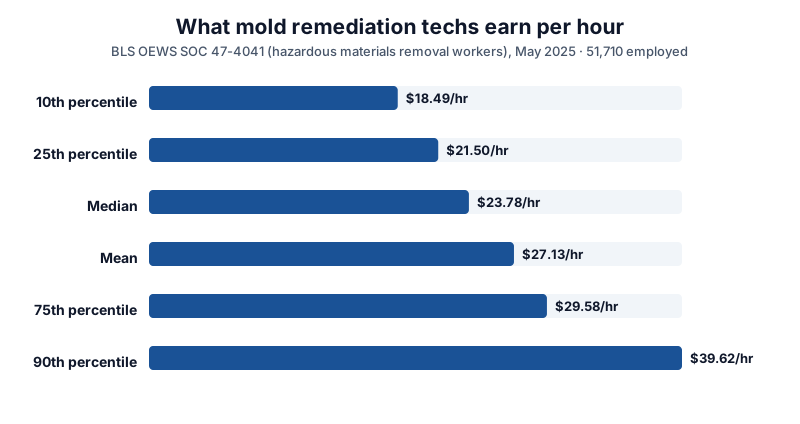
| Percentile | Hourly wage | Annual |
|---|---|---|
| 10th | $18.49 | $38,460 |
| 25th | $21.50 | $44,720 |
| Median | $23.78 | $49,450 |
| Mean | $27.13 | $56,430 |
| 75th | $29.58 | $61,530 |
| 90th | $39.62 | $82,410 |
About 51,710 people hold this job nationally. Now run the burden chain the same way you would for any trade — payroll taxes, workers' comp (restoration carries a higher class code than carpentry), the trailer, and the hours you pay for but can't bill. Using the math from our construction labor cost guide, that $23.78 median wage becomes roughly $38–$45 per hour all-in for a crew tech.
Here's the honest math on a typical job: two techs for two days at a $40 burdened rate is about $1,280 in labor. Bill the same job at 150 square feet of colonization, $25/sq ft, and you're at $3,750. Labor is a third of the bill — the rest is equipment, disposal, chemistry, and the margin that keeps the lights on.
Compare that to plumbing, where the median wage is $30.67 — more than 22% higher than your remediation techs. The labor side of this trade is cheap relative to the billing rate. That margin is exactly why the market is crowded with part-time operators, and why the ones who survive price containment and disposal honestly instead of competing the labor line down.
Pricing by Access and Square Footage
Remediation pricing guides put standard interior work at $10–$25 per square foot in 2026, with difficult-access areas like crawl spaces pushing $25–$30 per square foot. The mechanics behind that premium:
| Access class | What changes | Typical 2026 rate |
|---|---|---|
| Open interior (finished space) | Sheet plastic, standard HEPA | $10 – $25/sq ft |
| Crawl space, walkable | Confined-space setup, limited tool swing | $25 – $30/sq ft |
| Crawl space, tight (under 24") | Kneeling/crawling work, slower output per hour | $30+/sq ft, or day-rate |
One mistake new remediation contractors make: quoting per square foot on the crawl footprint instead of the treated surface area. A 1,000 sq ft crawl has roughly 1,000 sq ft of floor, 400 linear feet of stem wall at 2 feet high (another 800 sq ft), plus joists and subfloor sheathing if colonization reached them. The treated surface can be 2-3x the footprint. Price the surface, not the dirt.
Line Items That Make Your Quote Defensible
A crawl mold quote with one number gets shopped. A quote with these lines gets signed:
- Containment — poly sheeting at the crawl opening, negative-air machine with HEPA filtration. This is what keeps spores out of the living space, and it's the line DIY-adjacent competitors always skip.
- Removal and disposal — saturated insulation ($1–$2/sq ft of ceiling area), damaged vapor barrier, bagged and manifested. Disposal rules for moldy material vary by state; priced per load, not guessed.
- Surface treatment — HEPA vacuum, wire brush or soda blast on colonized wood, then an antimicrobial application. This is hours, and it's where the access premium earns its keep.
- Moisture source correction — gutter extensions, a sump or French drain if groundwater is the driver (our sump pump repair guide covers the repair side), grade correction, or a vapor barrier replacement.
- Post-remediation verification — either a third-party clearance test or your own moisture readings plus photos. Cheap insurance against the "it came back" call.
Small jobs carry overhead badly — a $1,800 job with a containment setup and a disposal run eats nearly as much overhead as a $4,000 job. Our overhead benchmarks show why the minimum-job charge in this trade needs to be $1,200 or higher, not the $500 the surface-cleanup band suggests.
Cleaning vs. Encapsulation: Where the Real Money (and the Real Risk) Sits
Angi puts crawl space encapsulation between $1,500 and $15,000 in 2026 depending on size, barrier weight, and whether a dehumidifier joins the system. That range is wide because encapsulation isn't one product — it's a vapor barrier sealed at the piers, vents closed or conditioned, and moisture control that keeps the relative humidity below the point where mold metabolizes.
Now the part nobody tells you: encapsulation is the upsell that separates honest remediation contractors from the ones the forums call scammers. The pitch "you need $12,000 of encapsulation" is sometimes true — and sometimes it's $800 of gutter work plus a $1,500 barrier upgrade that solves 90% of the problem.
Our decision matrix, field-tested against the way these jobs actually go:
| Situation | Recommend |
|---|---|
| Mold is surface-level, moisture source is a one-time event (burst pipe, one bad storm) | Clean and treat only — done |
| Recurring dampness, functional vapor barrier, gutters and grade fixable | Mold removal + site drainage fixes, revisit in a season |
| Recurring dampness, ground moisture is chronic, HVAC or ducts in the crawl | Full encapsulation + dehumidifier |
| Standing water every rain, structural wood moisture above 20% | Drainage contractor first, then remediation, then encapsulate |
That middle row is the one that builds a business. Fix the cheap thing, prove the moisture dropped, and you've earned the encapsulation sale — or the customer's referral when their neighbor has the same smell under their floor.
Insurance vs. Cash Pay
Insurance divides this work cleanly: mold from a sudden and accidental covered event (a burst supply line, a storm breach) is often covered up to the policy's mold cap, while mold from chronic seepage, humidity, or deferred maintenance almost never is. Flood damage needs a separate NFIP policy entirely.
For your quoting process, two habits follow. First, document the cause — photos of the failed line or the missing downspout extension determine whether the homeowner has an insurance path at all. Second, when the cause is maintenance-related, say so plainly and price the job as cash work. Homeowners who learn this from you instead of from a denied claim become the customers who take your encapsulation quote seriously.
Frequently Asked Questions
How much does crawl space mold removal cost per square foot?
Professional remediation runs $10–$25 per square foot in open interiors and $25–$30+ per square foot in crawl spaces, where confined access slows production (2026 remediation pricing guides). Price the treated surface area — floor, stem walls, joists — not the crawl footprint, or your quotes will run 2-3x light.
Can I remove crawl space mold myself?
A 10-square-foot patch of surface mold on the vapor barrier, with gloves, an N95, and a shop HEPA? Maybe. Anything more than that fails on three counts: you can't run negative pressure in a crawl, you shouldn't be crawling under a structure alone, and disturbance without containment spreads spores into the house. The EPA's guidance draws the DIY line around 10 square feet, and crawl spaces sit on the wrong side of it.
Does homeowners insurance cover mold removal?
Usually only when the mold follows a sudden, accidental event the policy covers — a burst pipe, a storm breach. Long-term seepage and humidity problems are maintenance, and maintenance mold is a cash job. Check the policy's mold cap before promising anything; many cap remediation well below a full-job cost.
Is crawl space encapsulation worth the money?
When ground moisture is chronic — damp soil, musty smells every summer, HVAC equipment living in the crawl — encapsulation plus a dehumidifier is the only fix that ends the cycle, and it protects the house for decades. When the moisture source is a one-time event or a fixable gutter, spending $8,000 on encapsulation is treating the wrong problem. Fix the water first, and encapsulate when the crawl proves it stays wet.
How long does professional remediation take?
A typical residential crawl job runs one to three days: setup and containment on day one, removal and treatment across the middle, teardown and verification at the end. Add time for demolition of wet insulation or a drying cycle if the subfloor got soaked. If someone quotes you "done in an afternoon," they're quoting a surface wipe, not remediation.
What's the difference between mold and efflorescence?
Efflorescence is white, powdery mineral salt left when water moves through masonry — it wipes off and comes back with the moisture, but it's not biological and doesn't need remediation. Mold is black, green, or brown, grows on organic material like wood and paper facing, and smears rather than powders when wiped. Misdiagnosing efflorescence as mold is one of the classic ways an upsell gets invented; testing is cheap compared to a $4,000 treatment that was never needed.
The Bottom Line
Crawl space mold removal is a $500-to-$8,000 trade where the spread is explained by access, demolition, and moisture correction — and where the crew's median wage is just $23.78 an hour. The contractors who win this market aren't the cheapest line on the comparison sheet. They're the ones whose quote shows containment, disposal, the moisture fix, and a verification step — because that's the quote the homeowner can defend to their spouse, and to the next bidder who comes in $900 lower and explains none of it.
Fix the water, price the surface, document everything. That's the whole playbook.