Your well pump quit and you're looking at a quote that could be $200 — or $2,500. Most repairs land between $300 and $600, with simple part swaps like a pressure switch at the $150–$200 end and full component replacements like a pressure tank at $800–$1,500+. A whole new pump runs $1,000–$2,500 installed.
Here's the one-line version before you scroll: if the fix is under about 50% of replacement cost and the pump is under 10 years old, repair it. Anything past that math, put the money toward a new pump.
Below you'll find the cost of each repair by part, a repair-or-replace matrix you can hold against your quote, and a plain-English breakdown of why the labor line on your invoice is bigger than the parts line.
Average Well Pump Repair Cost in 2026
| Typical repair range | $300 – $600 |
| Full range (simple part to major component) | $150 – $1,500+ |
| National average (all service calls) | ~$450–$975 |
| Full pump replacement, installed | $1,000 – $2,500+ |
Two numbers float around the internet, and both are right — they just count different things. HomeGuide's 2026 data puts the average repair at $300–$600 because it weights small part swaps. Angi reports $974 as its 2026 national average, based on 5,515 verified projects, because its sample includes bigger jobs like pulling and replacing pumps on deep wells.
For your budget, plan on $300–$600 for a common repair, and hold $1,500–$2,500 in reserve in case the diagnosis comes back "replace the pump."
But here's the thing — the total matters less than which part failed. That's what actually moves the number.
What Each Repair Actually Costs
Well pump systems fail one component at a time. The part that died decides your bill.
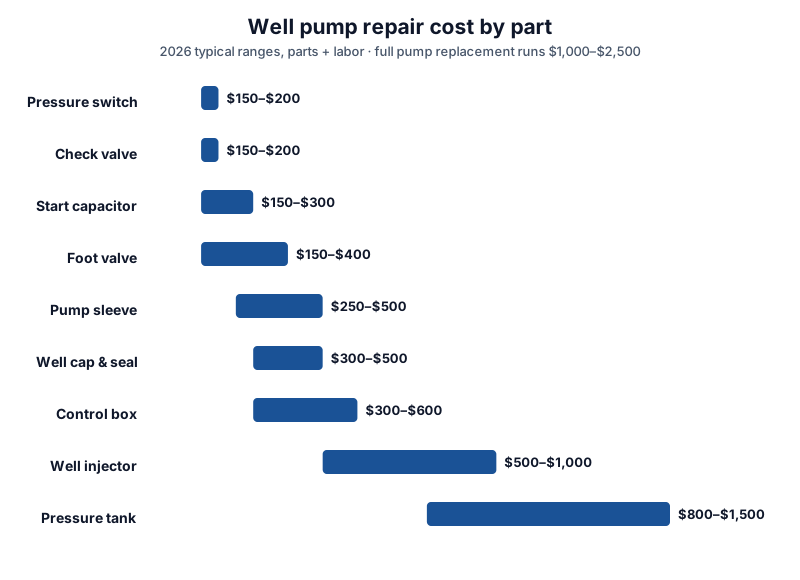
| Part | Typical cost (parts + labor) |
|---|---|
| Pressure switch | $150 – $200 |
| Check valve | $150 – $200 |
| Motor start capacitor | $150 – $300 |
| Foot valve | $150 – $400 |
| Pump sleeve | $250 – $500 |
| Well cap & seal | $300 – $500 |
| Control box | $300 – $600 |
| Well injector | $500 – $1,000 |
| Pressure tank | $800 – $1,500+ |
A few patterns worth knowing:
- Electrical parts are the cheapest fixes. Pressure switches, capacitors, and control boxes are bolt-on components sitting above ground or at the wellhead. Most of the bill is diagnosis time, not parts.
- Anything requiring pulling the pump multiplies labor. A submersible pump sits 100–400 feet down the well casing. The tech has to haul up the pipe section by section — that's where a $250 pump sleeve job becomes a half-day invoice.
- Pressure tanks are the expensive "repair." At $800–$1,500, you're replacing a tank that holds 20–40 gallons. If your pump is also 12 years old, this is where the replace-the-whole-thing conversation starts.
If your tank failed and the pump is old too, read the next section before you approve anything.
Repair or Replace? The Decision Matrix
You might be thinking the tech will just tell you what to do. Some will give it to you straight. Others make more on a $2,000 replacement than a $400 repair, so it pays to run the math yourself.
Here's the matrix we'd use, built from HomeGuide's 2026 repair-vs-replace guidance and pump lifespan data:
| Pump age | Single cheap part died (switch, capacitor, valve) | Big component died (tank, injector, motor) | Multiple failures this year |
|---|---|---|---|
| Under 8 years | Repair. Almost always. | Repair, but get 2 quotes | Repair |
| 8–12 years | Repair if bill < 30% of new pump | Run the 50% rule (below) | Start pricing replacement |
| 12–15 years | Repair only if the pump runs fine otherwise | Replace — don't sink money in a dying pump | Replace |
| 15+ years | Price a new pump while you repair | Replace | Replace |
The 50% rule: if the repair quote is more than half of what a new installed pump costs ($1,000–$2,500 where we live, so roughly $1,000–$1,250), replacement usually wins. A 12-year-old pump with a $900 pressure tank job is a 42%-of-replacement repair — borderline. A 14-year-old pump with the same quote is money you'll wish you'd put toward the new unit.
Turns out pumps rarely die alone. Once one major component goes at end of life, the others aren't far behind — they were installed the same week.
Why the Labor Bill Is So Big
Here's what most people don't know: the hourly rate you pay has almost nothing to do with the plumber's paycheck.
The Bureau of Labor Statistics tracks plumber wages in its May 2025 survey (SOC 47-2152). The median is $30.67 an hour. Even the top 10% of licensed plumbers earn $52.13. So how does a well service call run $75–$200 an hour, with two-person crews charging $150–$300?
The gap is overhead, and it's not padding:
- Truck and fuel — a well service van carries a pump hoist, pipe puller, and $10k+ of parts inventory
- Insurance — liability coverage for water and electrical work is one of the priciest trades
- License and well permits — many states require a separate well/pump contractor license on top of the plumbing license
- The drive — wells sit in rural areas. Forty minutes each way on a $150/hour book rate is real money the shop never bills
That's the 2.5–6x multiplier between wage and rate, and it's the same math whether you live in New Jersey (where plumbers average $46.97/hr per BLS) or Texas.
Now stack the pump on top: a submersible pump pull means a two-person crew, a hoist, and two to four hours of careful pipe handling. One dropped pump down a 200-foot casing and the tech's whole day is a loss. You're not paying for an hour of work — you're paying for the crew's ability to not drop your pump.
Emergency Calls: Why "No Water" Runs High
A customer calls at 7am in October: no water, kids need showers, work starts in an hour. Across plumbing forums, the "$1,000 for a one-hour job" complaint shows up over and over — and well pumps produce some of the most extreme versions of it.
Here's what that bill actually contains:
- Emergency dispatch premium — often $150–$300 above the standard service call, sometimes more on nights and weekends
- Diagnosis time — tracing whether the failure is pump, switch, tank, wiring, or the well itself runs 1–2 hours before any part is touched
- The repair itself — small, but real
- Guarantee — the shop is on the hook if it fails again next week
None of this makes a $1,100 same-day invoice feel cheap. But it does explain why the same pressure switch swap is $175 on a scheduled Tuesday and $450+ on a no-water Sunday.
Which means the cheapest emergency is the one you schedule early. If your pump has been short-cycling or the pressure's been sliding for a month, book the diagnostic before it becomes a Sunday-night call.
Warning Signs (and the DIY Trap)
Catch these early and you'll stay in the scheduled-service column:
- Short cycling — pump kicks on and off every few minutes with no water running. Classic pressure switch or waterlogged tank.
- Sputtering faucets — air in the lines means a check valve or foot valve is letting the system lose prime.
- Sliding pressure — starts strong, fades fast. Often a failing pressure tank.
- New noises — grinding or clicking from the wellhead area. Submersible pumps should be silent.
- Higher electric bills — a pump running harder than usual is working toward failure.
And the DIY trap: a pressure switch is a $25 part, and YouTube makes the swap look like a 20-minute job. Here's the reality — your pump circuit runs 220 volts, the switch wiring is what prevents the pump from over-pressurizing your tank, and a botched install can burn out a $900 pump motor or flood your wellhead. We've seen the forum threads where a $175 repair became a four-figure replacement because a DIY switch swap went wrong and the pump kept running against a closed line.
If you can run a multimeter and shut the breaker confidently, a switch swap is borderline DIY. Everything deeper than the wellhead is pro territory. (If the problem spreads into the house plumbing, our guide on the cost to repipe a house covers where that goes.)
How to Get a Fair Price
- Get three quotes for anything over $500. Well service is thin in rural areas, but even two quotes beats one.
- Ask if the service call fee applies to the repair. Many shops waive the $75–$150 diagnostic when you approve the fix. Some don't. Ask before the truck rolls.
- Demand the written breakdown — parts, labor hours, rate, and any after-hours premium on separate lines. Vague single-number quotes are where overcharging hides.
- Ask about the warranty. Reputable shops warrant pump repairs for 1 year on parts and labor. A 30-day warranty is a red flag.
- Verify licensing. Well pump work needs a license in most states — ask which one, then check it on your state's contractor lookup.
If you're in a high-cost region, expect quotes toward the top of every range above. And if the diagnosis is a bad pressure tank, compare it against what a sump pump repair costs before deciding your contractor only does big-ticket work — the same labor-rate logic applies there.
Frequently Asked Questions
How long does a well pump last?
8 to 15 years is typical. Submersible pumps usually outlast jet pumps because water cools the motor as it flows past. Hard water, heavy household use, and a mismatched pressure tank all shorten the clock. If yours is past 12, start a replacement fund even if it's running fine today.
Can a well pump be repaired, or is replacement always better?
Most component failures are repairable — switches, capacitors, control boxes, and valves are all fixable parts. Replacement wins when the pump itself (motor, impellers) fails at 10+ years of age, or when repair costs exceed about 50% of a new installed pump. The matrix above handles the borderline cases.
Why does my quote have a two-person crew on it?
Pump pulls and tank swaps need a second set of hands and lifting equipment — one person can't safely handle a 100-foot string of pipe with a pump on the end. Crews run $150–$300 an hour. For a simple above-ground switch replacement, one tech should cover it.
How fast do I need to act when the water stops?
Same-day or next-morning. A dry house is an emergency, but beyond comfort there's a practical clock: running a sputtering pump dry can destroy it, converting a $175 switch job into a pump replacement. Shut the pump off at the breaker if it's cycling with no water, then schedule the visit.
Is a service call fee the same as the repair cost?
No. The service call ($75–$150 typical) covers the truck roll and diagnosis. Many shops credit it against the repair if you proceed. Ask before booking — "is the diagnostic fee applied to the repair?" is a fair question and a good shop will answer it without hedging.
What warranty should a well pump repair include?
Look for 1 year, parts and labor, on both repairs and replacements. Pumps fail from installation errors as often as from bad parts, so a shop confident in its work will stand behind it in writing.
The Bottom Line
Most well pump repairs land between $300 and $600, electrical parts are the cheap fixes, and a pump past 12 years old with a major component failure is a replacement, not a repair. Get the written breakdown, apply the 50% rule, and schedule the diagnostic before "slow pressure" becomes "no water on a Sunday."
One last angle — if you're reading this as a contractor rather than a homeowner: well and pump work is some of the most profitable emergency service in the trade, but it lives and dies on fast, accurate quotes. Our plumbing estimating software guide covers the tools that handle service-call pricing, and JobTread is worth a look if dispatch and invoicing are part of your week. For the bidding math behind emergency rates, see how to price plumbing bids.
And if you're a homeowner staring at a full plumbing overhaul instead of one pump, our house repiping cost calculator gives you the broader numbers.